
One of the biggest challenges many traders encounter is not technical — it is psychological. People often approach trading seeking certainty: the right indicator, the perfect setup, or confirmation that price will move in their favour.
Markets do not operate in this way.
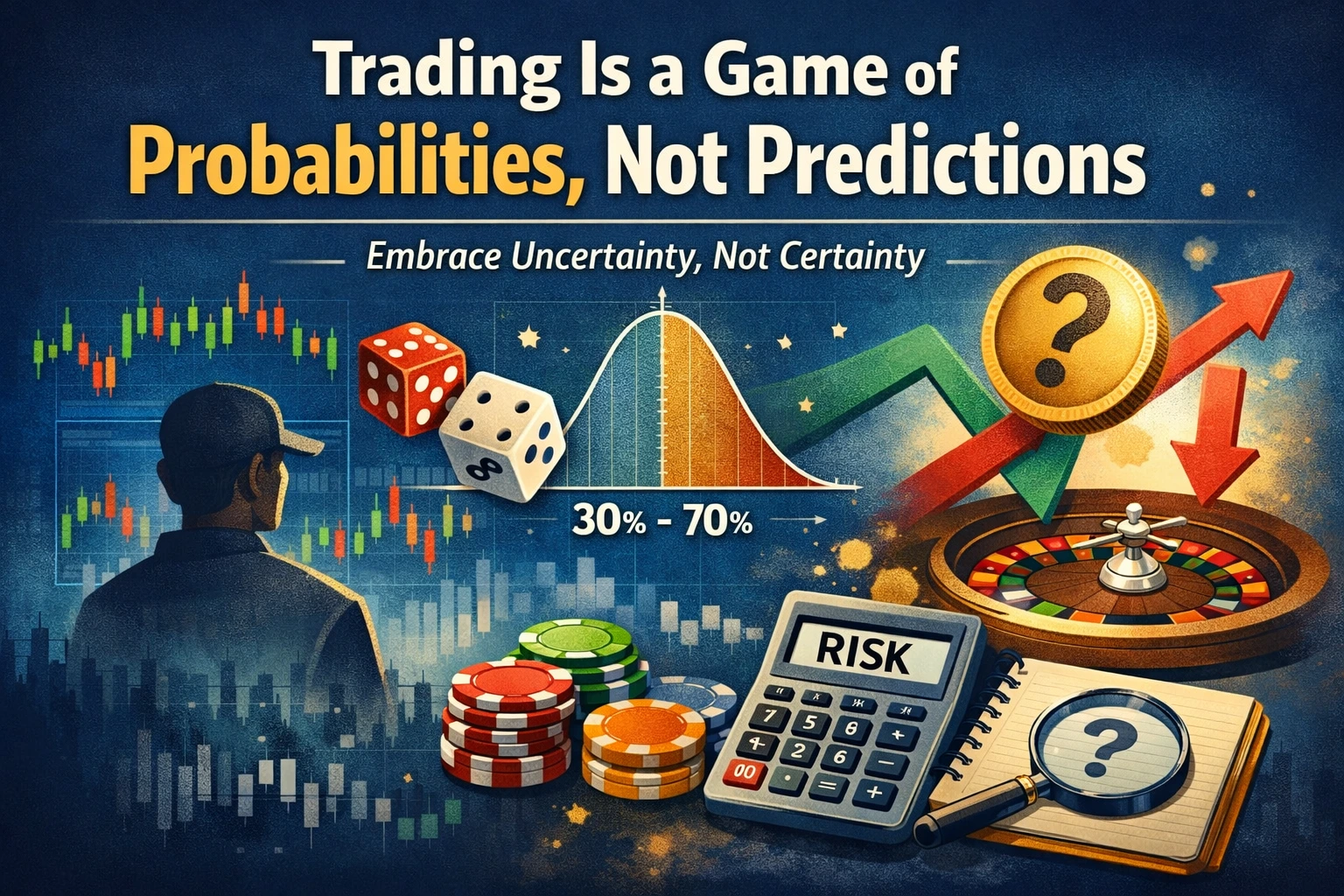
Trading takes place in an environment of uncertainty, where outcomes are probabilistic rather than guaranteed. When this reality is not fully understood, traders may find themselves working against the inherent randomness of financial markets rather than accepting it.
The Need for Certainty
Wanting to be right is a natural human tendency. In most areas of life, certainty and correctness are rewarded. In trading, however, this mindset can create problems.
When outcomes are judged on a trade-by-trade basis, losses often feel disproportionate, confidence can fluctuate unnecessarily, and decision-making may become influenced by short-term results rather than longer-term consistency. Markets do not reward certainty; they reflect variability. Even when decisions are made consistently, outcomes remain uncertain.
A single trade provides very limited information. Small sequences of results can also be misleading. Meaningful patterns only begin to emerge over larger samples of decisions.
Some traders explore this concept by examining historical assumptions or running hypothetical scenarios through simulators to observe how different outcome sequences can unfold.
What Thinking in Probabilities Means
Thinking probabilistically does not involve assuming positive outcomes or ignoring losses. It involves recognising that losses and drawdowns are an unavoidable feature of speculative markets and that short-term results can be noisy and misleading.
Each trade represents one possible outcome among many. When this is fully accepted, attention often shifts away from outcome-focused questions such as “Will this trade win?” toward process-focused considerations such as whether decisions were executed consistently.
This shift can reduce emotional pressure by reframing losses as part of participation in an uncertain environment rather than personal failure.
Why Losses Can Feel Personal
Losses often feel personal when variability has not been fully accepted. When outcomes differ from expectations, the instinct may be to intervene — adjusting rules, adding confirmation, or abandoning a process altogether.
In many cases, losses are simply a reflection of normal variability rather than evidence that something is broken. This does not imply profitability or strategy effectiveness; it simply acknowledges that losses alone do not provide sufficient information to draw conclusions.
Understanding probability can help traders tolerate uncomfortable periods without unnecessary interference in their decision-making process.
Process as the Constant
Market conditions change. Volatility expands and contracts, and environments shift in ways that cannot be controlled.
What remains within an individual’s control is how risk is approached, how consistently rules are followed, and how emotional responses to outcomes are managed. When results are recognised as uncertain, attention naturally moves toward process rather than prediction.
Many experienced traders describe effective trading as repeatable decision-making under uncertainty rather than a series of individual winning outcomes.
Why Mindset Matters More Than Tools
Indicators, price action, platforms, and tools all serve specific purposes, but none alter the underlying uncertainty of markets. Without a probabilistic perspective, tools can become emotional crutches rather than objective aids.
With a realistic mindset, traders may be better positioned to manage expectations, remain consistent during drawdowns, and evaluate performance without relying solely on short-term results. This does not guarantee success — nothing does — but it aligns behaviour with the realities of uncertain outcomes.
Final Thoughts
Trading does not reward prediction. It reflects discipline, patience, and an acceptance of uncertainty.
When individuals move away from trying to be right on every decision and instead acknowledge probability and variability, trading may feel calmer and more structured. Losses do not disappear, but the relationship with them often changes — and that shift can matter more than the result of any single trade.
Trading involves risk. Past performance, including simulated or hypothetical results, does not indicate future outcomes. This content is provided for general educational purposes only and does not constitute financial advice. You may lose some or all of your capital.