

Why This Distinction Matters
Many traders lump indicators into one mental bucket: tools that are supposed to tell them what will happen next. That misunderstanding is the root of a lot of frustration.
Indicators do not predict. They describe.
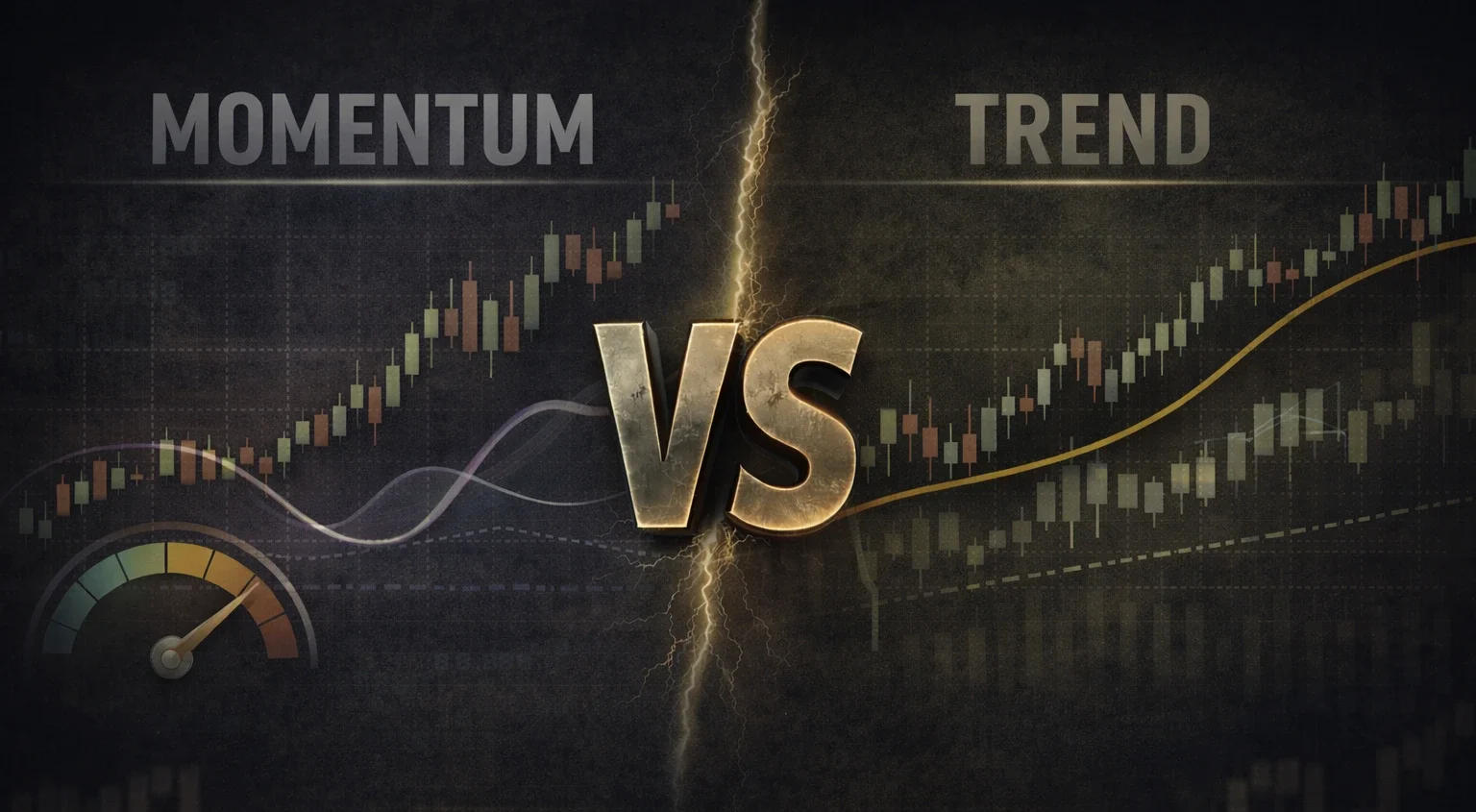
Understanding the difference between momentum vs trend indicators is one of the cleanest ways to improve how you read price, because it forces you to think in terms of market behaviour rather than forecasts. When you know what an indicator is actually measuring, you stop expecting answers it was never designed to give.
This article breaks down how momentum and trend indicators differ, what questions each one answers, and how they fit into a descriptive approach to market analysis.

What Trend Indicators Are Really Measuring
Trend indicators describe direction and structure over time. They help answer a single question:
Is price generally moving up, down, or sideways over this window of time?
They do this by smoothing price data. That smoothing is not a flaw, it is the entire point. By filtering out short term noise, trend indicators highlight the broader path price has already taken.
Common examples include moving averages, moving average crossovers, and trend channels. If you want a deeper breakdown of how smoothing actually works, see How Moving Averages Really Work. Regardless of the specific tool, they all share two characteristics:
- They react after price has moved
- They prioritise clarity of direction over speed
This is why trend indicators feel “late” in fast markets. They are not designed to capture the first move. They are designed to confirm that a move has existed long enough to matter.
In practical terms, trend indicators are most useful for contextual questions:
- Is the current move aligned with the broader structure?
- Has direction meaningfully changed compared to recent history?
- Is price expanding away from its average behaviour or reverting back toward it?
Notice what is missing here: none of these questions involve prediction.
What Momentum Indicators Are Really Measuring
Momentum indicators describe the rate of change in price movement. Instead of asking where price is going, they ask:
How fast is price moving relative to its recent behaviour?
Momentum focuses on acceleration and deceleration. It highlights whether buying or selling pressure is strengthening or weakening right now compared to the recent past.
Indicators like RSI, MACD, and Stochastic Oscillators fall into this category. Each of these is explored in more depth in the Tick Flow guides on RSI Explained: Momentum, Not Overbought and Oversold, MACD Explained: Momentum Over Signals, and Stochastic Oscillator Explained: Understanding Momentum. Despite their differences, they share common traits:
- They respond faster than trend indicators
- They fluctuate as pressure builds and fades
- They are sensitive to short term shifts in behaviour
Momentum indicators are often misunderstood because traders treat levels or signals as predictive triggers. In reality, momentum tools simply show whether current price movement is expanding, slowing, or stalling.
Used correctly, momentum helps answer questions such as:
- Is participation increasing or decreasing?
- Is the current move gaining energy or losing it?
- Is price pushing aggressively, or drifting?
Again, these are descriptive questions, not forecasts.
Momentum vs Trend Indicators: The Core Difference
The simplest way to understand momentum vs trend indicators is to think in terms of time horizon and behaviour.
Trend indicators summarise what price has been doing over a longer window. Momentum indicators zoom in on how price is behaving within that structure.
A market can be in an uptrend while momentum weakens. It can also show strong momentum while still sitting inside a broader sideways range. Neither condition is a contradiction, they are describing different aspects of the same data.
This is where many traders get stuck. They see disagreement between indicators and assume something is “wrong.” In reality, the indicators are simply answering different questions.
Why Neither Type Works Well in Isolation
Using only trend indicators often leads to late entries and exits, because structure changes slowly.
Using only momentum indicators often leads to overtrading, because short term pressure fluctuates constantly.
The problem is not the tools themselves. The problem is expecting a single indicator to provide complete market context.
Trend without momentum lacks timing.
Momentum without trend lacks structure.
Understanding this prevents a common trap: endlessly switching indicators in search of confirmation, when the real issue is conceptual, not technical. This idea is expanded further in Why Indicators Don’t Predict Price (And What They’re Actually Useful For).
A Descriptive Way to Combine Them
In an educational, non predictive framework, trend and momentum indicators are best used as layers of description.
Trend indicators define the environment. They tell you what type of market you are observing.
Momentum indicators describe behaviour within that environment. They show whether participation is expanding or contracting relative to recent history.
This approach avoids signal chasing and keeps analysis grounded in observable information. It also aligns closely with the Tick Flow perspective outlined in Why Trading Is a Game of Probabilities, Not Predictions. You are not asking indicators to tell you what will happen next. You are using them to understand what is happening now, in context.
Common Misinterpretations to Avoid
One of the most damaging habits in trading education is assigning predictive meaning to descriptive tools.
Momentum turning down does not mean price must reverse. It means upward pressure is slowing relative to the recent past.
A trend indicator flipping direction does not mean a new trend has begun. It means recent price behaviour has differed enough from prior behaviour to change the average.
When traders internalise this distinction, indicators stop feeling contradictory and start feeling complementary.
Final Thoughts
The debate around momentum vs trend indicators is not about which one is better. It is about understanding what each one is designed to describe.
Trend indicators provide structural context.
Momentum indicators provide behavioural insight.
Neither predicts. Neither guarantees outcomes. Both are tools for interpreting price data in a structured, repeatable way.
When used with correct expectations, indicators become less emotional and far more useful not as signals, but as lenses through which price action can be understood.
This content is provided for educational purposes only and reflects a descriptive analysis of market behaviour. It does not constitute financial advice, investment recommendations, or an invitation to trade any financial instrument.
All indicators discussed are used to describe historical and current price data. No indicator or methodology guarantees outcomes or predicts future market movements. Trading and investing involve risk, and past performance is not indicative of future results. You are solely responsible for any decisions you make based on this information.