

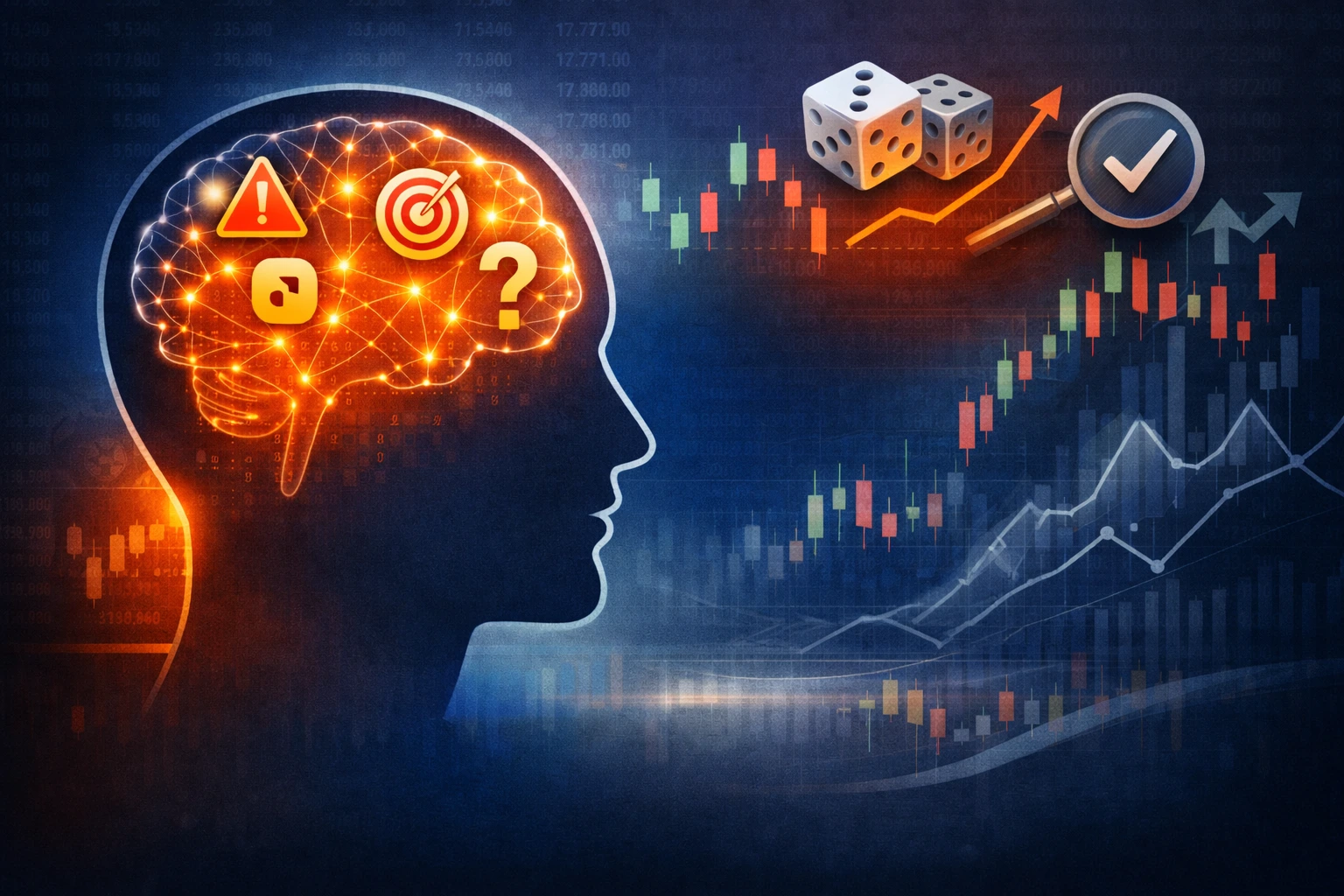
Cognitive biases in trading influence how decisions are made under uncertainty, often without traders realising it. Most trading mistakes are not caused by a lack of knowledge, indicators, or tools, but by how the human mind responds to risk, loss, and ambiguity.
Trading requires decisions to be made in an environment where outcomes are never guaranteed. The brain, however, prefers certainty, control, and immediate feedback. This mismatch is why many traders struggle even when they understand risk, probability, and structure in theory.
Cognitive biases sit quietly in the background of this process. They influence decisions without asking permission.
Why Bias Matters in Trading
A trading strategy can be statistically sound and still fail when executed by a human being. Bias doesn’t mean a trader is careless or undisciplined. It means they are human.
The mind evolved to protect against danger and discomfort. In trading, that same protection often pushes traders away from rules and toward emotional relief. When this happens repeatedly, inconsistency becomes the norm rather than the exception.

Understanding bias doesn’t remove it, but it helps explain why trading feels more difficult in practice than it does on paper.
Loss Aversion
Losses tend to feel heavier than gains of the same size. A losing trade can linger emotionally long after it’s closed, while a winning trade is quickly forgotten.
In trading, this often leads to holding losing positions longer than planned or exiting profitable trades too early. The decision is rarely about logic. It’s about reducing emotional discomfort.
Over time, loss aversion can distort risk management, even for traders who intellectually understand the importance of fixed risk.
Recency Bias
Recent experiences tend to feel more important than they actually are.
After a sequence of losses, traders may feel as though a strategy has stopped working. After a few wins, confidence can rise quickly, sometimes leading to behaviour that wouldn’t normally fit the plan.
Markets operate on probabilities over long samples, not on short emotional timelines. Recency bias compresses those timelines and encourages decisions based on what just happened rather than what tends to happen over time.
This is one reason losing streaks often feel personal, even when they are statistically normal.
Confirmation Bias
Once a trader forms an opinion, the mind naturally looks for information that supports it.
After entering a trade, it becomes easy to focus on data that confirms the position while downplaying signs that the original idea may no longer be valid. This doesn’t require deliberate ignoring of information. It happens subconsciously.
Confirmation bias can turn analysis into justification, especially when money and emotion are already involved.
Outcome Bias
Outcome bias occurs when the quality of a decision is judged entirely by its result.
A well planned trade that loses money can feel like a mistake. A poorly structured trade that makes money can feel validated. Over time, this creates confusion about what actually works.
Trading decisions are best evaluated by whether rules were followed and risk was controlled, not by whether the trade happened to win or lose. When outcomes dominate learning, traders often reinforce habits that are unsustainable long term.
The Illusion of Control
Many traders believe that more analysis, more tools, or more effort will eventually remove uncertainty.
While preparation matters, markets remain uncertain regardless of how much work is done. The belief that uncertainty can be eliminated often leads to over analysis, constant adjustment, and unnecessary activity.
Consistency tends to improve not when control increases, but when uncertainty is accepted and risk is managed accordingly.
Managing Bias, Not Eliminating It
Cognitive biases do not disappear with experience. They are managed through structure.
Clear rules, predefined risk, and separating decision quality from outcomes all help reduce the influence of bias. The goal is not emotional neutrality, but behavioural consistency.
Bias is most damaging when it goes unnoticed. Awareness does not stop emotional reactions, but it can stop those reactions from dictating behaviour.
A More Useful Way to View Trading Psychology
Trading psychology is often framed as a personal weakness. In reality, it is a predictable response to an uncertain environment.
Understanding cognitive bias reframes many trading struggles. Difficulty following rules, fluctuating confidence, and emotional reactions to normal losses are not signs of failure. They are signs that the mind is doing what it was designed to do.
Successful trading is less about changing human nature and more about building systems that work with it.
Disclaimer:
This article is provided for educational purposes only and does not constitute financial advice, investment advice, or a recommendation to trade any financial instrument. Trading involves risk, and losses are a normal part of market participation. Past outcomes are not indicative of future results.