
Using Stochastic Oscillator to Observe Momentum
The stochastic oscillator is frequently misunderstood and often misused. It is commonly presented as a tool for identifying overbought and oversold conditions, which can lead to the assumption that it predicts future price reversals.
What Is the Stochastic Oscillator?
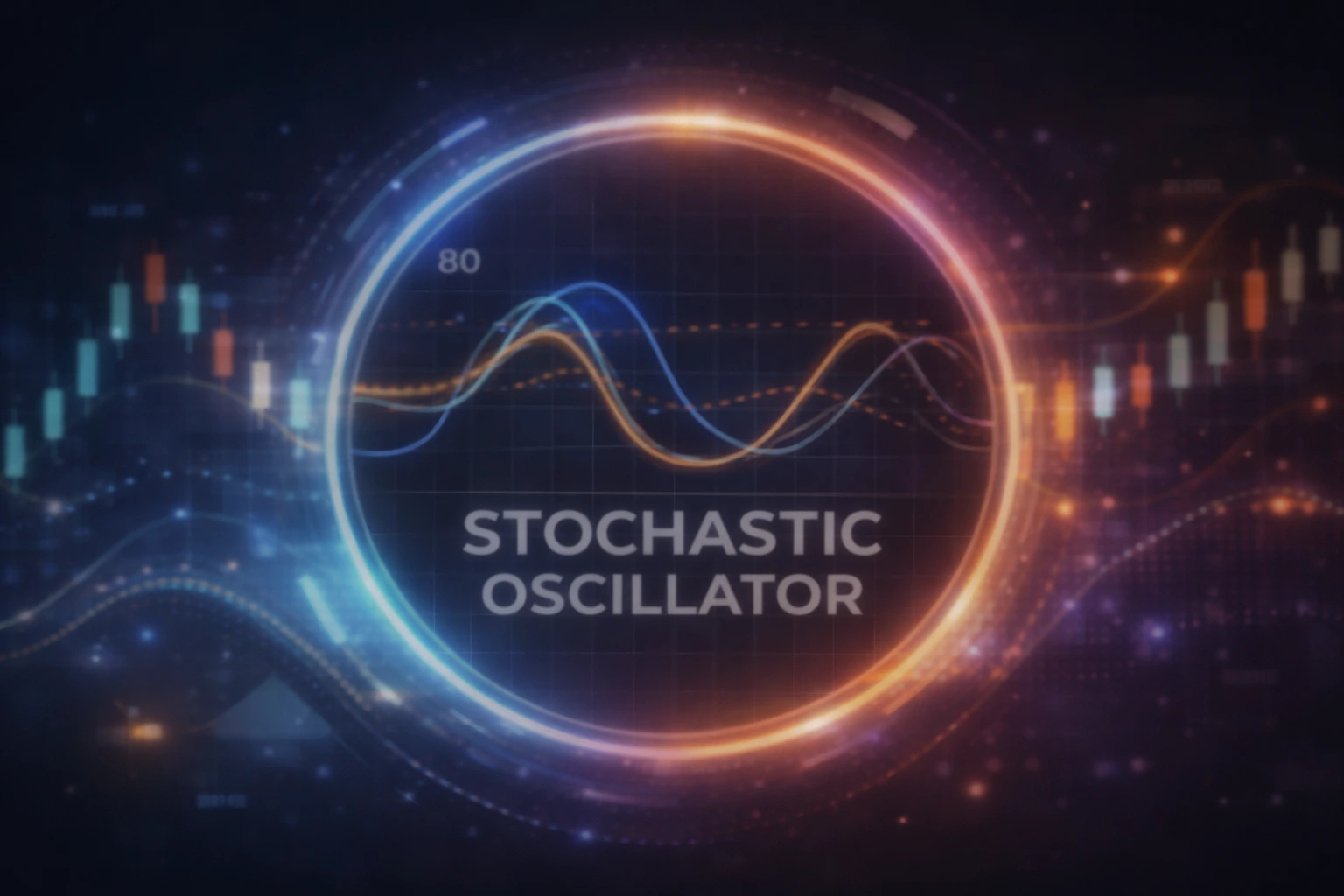
The stochastic oscillator is a technical indicator that compares a market’s closing price to its recent trading range.
Rather than attempting to forecast future price movements, it answers a descriptive question:
Where has price been closing relative to its recent highs and lows?

By answering this question, the indicator provides information about momentum based on past price data.
Conceptual Overview of How It Works
At a high level, the stochastic oscillator:
- Identifies the highest and lowest prices over a defined historical period
- Compares the most recent closing price to that range
- Displays the result on a scale from 0 to 100
The indicator typically consists of two lines:
- %K, which reflects short term momentum
- %D, which is a smoothed version of %K
These values describe relative closing strength over a historical window. They do not indicate future price direction.
Clarifying “Overbought” and “Oversold” Terminology
Terms such as overbought and oversold are widely used but can be misleading if interpreted as predictive.
From a descriptive standpoint:
- Higher stochastic readings indicate that price has been closing nearer to the top of its recent range
- Lower readings indicate that price has been closing nearer to the bottom of its recent range
These observations describe past market behaviour, not whether price is likely to rise or fall next.
Observing Momentum With the Stochastic Oscillator
When used appropriately, the stochastic oscillator can help describe:
- Changes in historical momentum
- Periods of stronger or weaker price pressure
- Shifts in momentum that occur after changes in price behaviour
For example:
- Rising readings reflect increasing upward momentum in recent price action
- Falling readings reflect increasing downward momentum
- Relatively stable readings suggest limited momentum change
All of these observations relate to what has already occurred in the market.
Importance of Market Context
The stochastic oscillator should always be interpreted alongside broader market context, such as:
- Whether the market has been trending or ranging
- How price has behaved around previous levels
- The prevailing volatility environment
The indicator does not function independently and should not be used as a standalone decision making tool.
Common Misinterpretations
Some frequent misunderstandings include:
- Treating indicator crossovers as buy or sell instructions
- Assuming fixed numerical levels imply future reversals
- Expecting the indicator to lead price rather than reflect it
Technical indicators are lagging by nature, as they are derived from historical data. This characteristic is inherent and does not reduce their descriptive value.
Educational Use and Probabilistic Thinking
At Tick Flow, technical indicators are discussed within a framework of probabilistic and descriptive analysis.
The stochastic oscillator may contribute to this framework by:
- Helping describe historical momentum conditions
- Supporting structured market observation
- Adding context without implying certainty
It does not predict outcomes or remove uncertainty.
This reflects the broader Tick Flow principle outlined in “Why Indicators Don’t Predict Price (And What They’re Actually Useful For),” where indicators are framed as tools for observation, not forecasts.
Final Notes
The stochastic oscillator is best understood as a tool for observing historical momentum, not forecasting future prices.
Understanding what an indicator describes and what it does not helps set realistic expectations and supports more disciplined market analysis.
Trading financial markets involves risk and may not suit all investors. Tick Flow content is for educational purposes only and does not constitute financial advice. Past performance does not indicate future results. Nothing in this article should be considered a recommendation to trade or invest.